“How to Guide”
By Dr Helen Tighe and Alicia Butterfield
What is a Readiness Assessment
A readiness assessment in the context of the Global Electric Cooking Coalition (GeCCo) is a practical framework for determining whether the right conditions are in place to scale electric cooking solutions. It identifies gaps and opportunities and prioritises activities. An eCooking readiness assessment:
- Are ideally done in in discussion with the country government in question
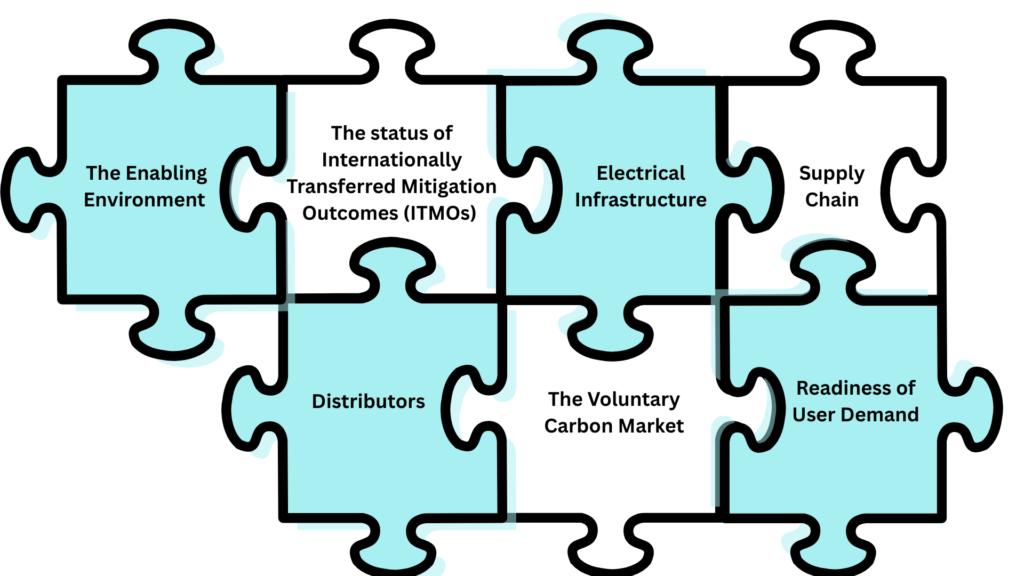
- Comprises seven components, based on the MECS jigsaw methodology for eCooking transition. The MECS jigsaw methodology treats the transition from traditional cooking fuels to clean cooking not as a linear process but as a complex system where many interdependent aspects must be in place for transition to occur.
The seven components are:
- The status of Internationally Transferred Mitigation Outcomes (ITMOs)
- The Voluntary Carbon Market,
- Readiness of User Demand,
- Electrical Infrastructure,
- Supply Chain,
- Distributors, and
- The Enabling Environment.
The report also identifies the process for stakeholder buy in and scaled delivery via Carbon Finance.
Timeline
Readiness Assessments are conducted within three months and typically act as a baseline study ahead of the development of a full National eCooking Strategy.
Ownership and Use of the Readiness Assessment
The readiness assessment is owned by the country government to be utilised as they wish. It’s also useful to stakeholders including the national utility, mini grid developers, GeCCo members, funding partners, implementation organisations and NGOs who are planning eCooking pilots or similar. Therefore, two readiness assessment resources are produced; one for the government consumption which may include sensitive data, and a second version for public dissemination.
Why are they necessary
A readiness assessment is important because it ensures that efforts to scale electric cooking are evidence-based, targeted, and effective. Rather than applying one-size-fits-all solutions, it helps stakeholders understand the specific constraints and opportunities within a market, reducing the risk of failed interventions and misallocated resources.
. By clearly identifying where support is most needed—whether in policy, infrastructure, finance, or consumer engagement—it enables more strategic investment, stronger coordination among partners, and faster, more sustainable adoption of eCooking. Readiness Assessments also pave the way for further planning support for transition, such as the development of national eCooking strategies, or eCooking components for Clean Cooking strategies.
Who is the guide for?
Any organisation looking to complete (or support the completion of) an assessment to characterise the readiness of a country for eCooking transition. This includes, but is not limited to, international multilateral Civil Society Organisations, Philanthropic Donors, private companies and country governments.
The Readiness Assessment itself is best conducted by a local organisation, or regional organisation with strong local contacts, and this guide presents the process undertaken to commission an organisation to conduct a Readiness Assessment.
The readiness assessment process
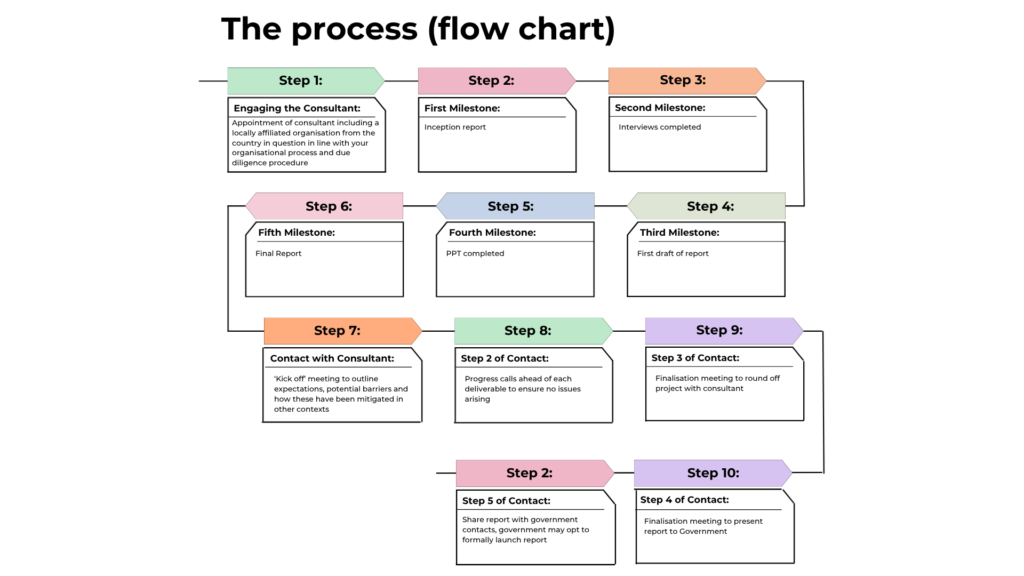
Consultant Activities:
| Initial Stakeholder Consultation | The first step is to conduct initial stakeholder consultation using a variety of methods. The first is a series of interviews utilising the consultant’s local networks within the country. Key stakeholders from across the eCooking landscape should be consulted including, but not limited to, government officials, national utilities, energy regulators, rural electrification agencies, energy access stakeholders, community groups, women’s groups and national standards bureaus. The wider community should further be engaged through focus group and conducting household surveys to assess user demand. To date we have not specified the methodology used in our ToRs but assessed what consultants propose during our shortlisting procedure. |
| Literature Review | Whilst the consultant is conducting stakeholder consultations, desk based research should be undertaken in parallel with, to capture existing information on the seven elements of the jigsaw methodology from for example clean cooking and energy policies, M300 energy compact (if applicable), other relevant initiatives e.g. deforestation or charcoal reduction units. |
| Initial Draft Report | Completed components of the Readiness Assessment submitted for technical and operational review by commissioning organisation. |
| Validation Workshop | Key stakeholders invited to attend a workshop outlining the principal findings of the report. Typically includes presentation of PPT slide deck summarising the Readiness Assessment findings, an eCooking demonstration and some examples of eCooking projects already underway in the region. |
| Final Report | Feedback from commissioning organisation’s review is incorporated, feedback from the validation process incorporated, finalisation of report and recommendations. |
Comparative Study Report
Review of Readiness Assessments Conducted to Date:
Resources and Templates
ToR Template:
TOR Advert Template:
Lessons learned – What is the best practice for future readiness assessments?
- Within readiness assessments conducted to date there is a strong focus on barriers and readiness gaps. Moving forwards more emphasis should be added on market opportunities and positive enabling trends to create a more balanced narrative.
- Weaker RAs contained limited operational detail in their recommendations, they didn’t identify a clear delivery model or lead actors or attempt to quantify targets.
- Strong RAs present alignment between their conclusions and recommendations, with operational detail that moves beyond ‘what needs doing’ to ‘how it could be done’.
- Good reports ranked identified barriers into strategically appropriate priorities to address and offered potential solutions to overcome them to facilitate a pathway to eCooking transition.
- Future readiness assessments should at the very least outline the additional research/ policy documents/ actions by decision-makers required to make the necessary changes. Tying in with the current work IRENA is doing on investment portfolios, a strong readiness assessment report could cost potential interventions/actions to facilitate eCooking transition within a country, to be used by Country Governments
- Report lengths varied significantly (43–115 pages), with many containing excessive background/contextual information; concise, focused reporting was recommended to improve accessibility and usability.
- While gender considerations are acknowledged they tend to primarily remain linked to the user demand section. Moving forwards this should be something that is consistently integrated across all thematic areas.
- The level of detail around methodology varies across reports – strong reports provided detailed research questions and in-depth information about their methods. Future readiness assessments may benefit from greater methodological consistency, particularly around gender representation, and stakeholder sampling.
FAQ’s
What are the benefits of a readiness assessment?
- Targeted action
Identifies the most critical barriers and where to intervene first. It’s easy to list all the potential barriers to eCooking, especially in regions with low electricity access. But the readiness assessment can highlight ‘low hanging fruit’ as well as prioritise major obstacles . It also considers the potential for eCooking to be embedded within energy policy or planned electrification projects to enhance demand for new electricity supply.
- Efficient resource allocation
Helps direct funding and effort to the highest-impact areas
- Evidence-based decision making
Grounds strategies in data rather than assumptions. We often hear ‘cooking with electricity is too expensive’ – however, the data demonstrates its financial viability compared to other inefficient or subsidised fuels. The readiness assessment can highlight the conditions needed to ensure financial viability of eCooking.
- Market clarity
Provides a clear picture of opportunities, risks, and readiness gaps
- Stronger coordination
Aligns governments, donors, and partners around shared priorities which are clearly articulated.
- Accelerated scale-up
Enables faster and more sustainable adoption of electric cooking by mapping existing activities and projects across a range of actors.
- Risk reduction
Minimises the likelihood of unsuccessful or poorly designed interventions by joining up moving parts.
- Progress tracking
Creates a baseline to monitor improvements over time.
How important is collaboration with country governments?
Collaboration with governments is critical because they shape the enabling environment for electric cooking at scale. Governments set policies, regulations, and standards that can either accelerate or hinder adoption, and they play a central role in energy planning, electrification strategies, and public financing. Working closely with them ensures that eCooking is integrated into national priorities, unlocks long-term investment and policy support, and enables alignment across sectors (energy, health, climate, and development). Without government engagement, efforts risk remaining small-scale, fragmented, and unsustainable.
Why is the readiness assessment standardised from one country to another, why can’t the country government determine what is included in their own readiness assessment?
The seven readiness assessment components are standardised to ensure consistency, completeness, and comparability across countries. This makes sure no critical areas are missed, enables cross-country learning, and provides a credible, evidence-based framework that donors and partners can trust.
However, this doesn’t exclude governments from self-determination— the framework is flexible in how it’s applied, allowing countries to adapt the analysis and priorities to their specific context. In short, standardisation ensures rigour, while government input ensures relevance and ownership.
What can a readiness assessment lead to?
- Clear action plan
Prioritised recommendations for scaling electric cooking to focus efforts of the stakeholders who wish to see this transition e.g. it can form the baseline study for a National eCooking strategy.
- Policy and regulatory reform
Can enable and accelerate eCooking adoption by providing the evidence needed to demonstrate the viability and benefits of eCooking e.g. to support specific reference to eCooking in a country’s NDC revisions.
- Targeted investment
Mobilisation of funding for infrastructure, markets, and programmes e.g. can support the case for eCooking load provision to national utilities or mini grid developers
- Pilot projects and programmes
Guiding content and solutions needed in key segments and regions e.g. piloting eCooking in schools which can be scaled up nationally or transferred to other countries
- Market development
Growth of supply chains, businesses, and service providers by highlighting existing market provision and gaps to be addressed e.g. coordinated RBF initiatives to support market development
- Stronger stakeholder alignment
Coordinated action across government, donors, and partners
- Integration into national strategies
Inclusion of eCooking in existing energy, climate, and development plans to enhance mini grid profitability and provide an anchor load for the national utility, as well as enhance new initiatives such as Mission 300
- Monitoring and evaluation frameworks
The development of tools to track progress and impact over time to bring us closer to meeting the SDG 7.1.2 target
What should we look for in potential consultants?
It is important to look for a combination of technical expertise, local knowledge, and strong delivery capability. Consultants should have a solid understanding of energy access and electric cooking, alongside familiarity with the country’s policy landscape and market dynamics. Aside from the obvious general skills such as good communication and strong analytical skills to generate clear, evidence-based insights, they also need the ability to engage effectively with government sources, private sector actors, and development partners.
The most successful readiness assessments came from understanding that embedding eCooking provision in future electrification projects represented a ‘win-win-win-win’ for the government, the end user, the investors and the environment- the consultants sought to remove the barriers and capitalise on opportunities of achieving this.