By Isabel Risby, GeCCo Communications Officer
Disclaimer: The following characterisations do not refer to the lives of specific individuals. Rather, they are an imagined collation of lived experiences and situations that we know to exist, and are daily reality for many thousands of people worldwide.
Sabina, situated in a refugee camp:
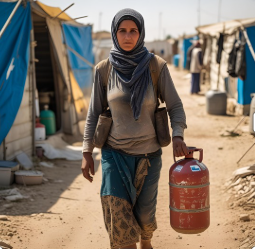
Sabina is awaiting her LPG refill, which is scheduled for today, she must reach the distribution centre, where the supply chain operations are coordinated. She needs to arrive early since she cannot rely on receiving a canister. The queue is long and tiresome, and she and her family haven’t eaten yet. Sabina presents her distribution card as she lifts the canister up – a routine etched into the rhythms of displacement. Luckily, she receives a full refill. Once complete, she lifts the canister and carries it back to her dwelling, a 20-minute walk away. The canister is heavy and puts strain on her shoulder and arm. Upon her arrival, Sabina finds her children playing outside, she’s always wary of leaving them whilst she makes the trip. She can sense among them that they are growing hungry. Once inside, she pulls up a bag of lentils and connects the gas stove, careful to make sure the gas is off, in preparation to cook. Sabina is careful with the gas, as the demand in the camp is high and this is pushing up prices. With the supply sometimes being unreliable, she tries to use it sparingly. However, electric pressure cookers (EPC) and solar e-cookers are becoming introduced in her area, a new innovative appliance becoming a preference for many. Especially due to the added benefit that solar e-cookers require no electricity from the national grid. Electric cooking is not only safer and healthier for her family and the environment, but it also can empower Sabina in reducing her dependence on distributions and unstable logistics when it comes to LPG fuel. This practical solution would transform Sabina’s cooking experience—providing access to clean, safer energy that doesn’t emit harmful gases. It protects her family’s health while making cooking more accessible, affordable, and dignified.
Zuri, internally displaced situated in a host community:
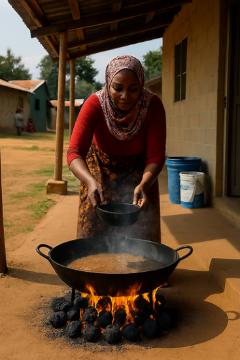
Zuri and her family have had to move locations due to a series of conflicts that have spilled into their home community. Her and her family are now relocated to a new host community. In their new host community, the family find the principle is the same, to cook a meal you need charcoal. Zuri is relieved to find that charcoal is still as available, a small comfort amid the upheaval. However, the supply is limited, and prices have crept up. This is due to the excessive deforestation and plummeting of charcoal due to limited wood supply. This pressure leaves families like Zuri’s with limited options; however, limits can be overcome – with the solution of eCooking. With the solution of eCooking Zuri would not have to rely on charcoal, protecting her and her family’s health, protecting the forest and supplying a reliable source of energy. In her current situation Zuri finds demand of charcoal is high and many have had to turn to alternatives, which has also created subtle tensions among neighbours. Zuri’s success means she remains discreet and relocates to the outside porch. She carefully lights her charcoal stove (she locally bought at the host community market) and sets her pan over the glowing embers. The smoke curls upward into the air, forming a thick, dark cloud – the flame emits black carbon, a potent climate pollutant – it stings Zuri’s eyes. She avoids breathing it in– as well as her children who move away as it pollutes the house. The effects of burning charcoal are extremely harmful and change needs to happen. As eCooking and solar eCooking progresses into communities, charcoal can be eliminated. With the additional start-up of mini-grid projects that are underway, energy access can be provided through renewable energy, but in the meantime solar energy is an innovative approach in solving energy access gaps, providing families like Zuri’s a better alternative of solar electric cooking, which is safer, healthier and can provide reliable energy through the power of the sun.
Adowa, situated in a rural community with finite resources:
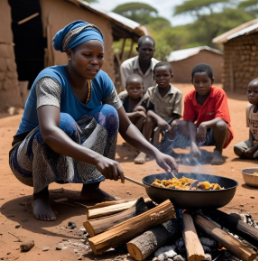
Adowa wakes up and one of the first jobs of her day is to collect firewood from the nearby forest, the forest is depleting and it’s getting harder to source wood. She finds there are rising tensions amongst the community, and she worries about her safety every time she ventures into the forest. Adowa’s growing fears are becoming a bigger problem day by day, she has a family to provide for, and lack of firewood increases her anxieties. Adowa’s husband, instead of working on crop farming, has had to become involved with the firewood collecting process. This is due to firewood becoming scarce in the nearby area, and longer distances need to be covered, the constant cycle has become a daily acceptance and entrapment for the family – impacting everyone. Even Adowa’s children must miss school to help gather firewood. She’s found her husband has become more irritable and angrier due to his inability to farm. Adowa fears the growing tension and additionally finds cooking a painful and tiresome process – a shared experience for many in last mile cooking setups. However, solar/electric cooking can resolve this array of issues, empowering Adowa to focus on other tasks, her children could attend school and her husband could farm – all due to the reliable source of energy in their home. A hopeful future for Adowa and her family as these technologies surface in her community, with the power of solar and renewable energy developments there is progress on these projects reaching her community.
Introduction
These three characterisations pose an insight into many of the situations individuals and families worldwide find themselves experiencing on a day-to-day basis. This blog aims to highlight that even in the most challenging displacement and last mile community settings- eCooking can work. This blog will discuss how eCooking is working, how it is working already, and the overarching benefits it can- and is- providing.
For reference, the term Last Mile Community refers to the umbrella term that encompasses those living in rural settings, displaced settings, refugee settings, informal settings, as well as those internally placed or situated in slums.
Can eCooking work anywhere?
As posed by the characterisations, energy access in hard-to-reach settings still has a way to go. The latest IEA report (Link here) based upon Clean Cooking in Africa states, ‘Access to clean cooking remains among the most urgent, and often overlooked, issues in global energy systems, with dire implications for health, development, education, and the environment.’ (1). The reality is that in 2023, over 2 billion people worldwide – nearly one in four people – still rely on traditional stoves and open fires’ (1). And in addition, The ESMAP 2020 report, (Link here), identifies a further 4 billion as not having access to modern energy cooking (which means higher tier stoves that have such low household air pollution that they don’t affect health) (2), highlighting a significant gap in energy access worldwide.
However, eCooking is shifting cooking practices worldwide. The advancement of stand-alone solar systems (with or without battery provision), mini grid developments and national grids powered by new renewable energy sources, are increasingly supporting widespread electrification. MECS research has demonstrated that integrating eCooking into new energy provision supports the transition to clean cooking while simultaneously improving load factors, increasing revenues, and enhancing the profitability and scalability of utilities and mini grids.
But do these solutions reach last mile communities?
Whilst there are barriers to eCooking in last-mile settings such as appliance cost, availability of appliances, and electricity supply, eCooking solutions can emerge and these barriers can be mitigated.
Firstly, appliance cost as a barrier can be mitigated through subsidisation by development organisations. Agencies can help to address the upfront cost of appliances through innovative financing mechanisms, such as ATEC Global’s ‘Cook to Earn’ pilot, which demonstrate how innovative financing models can reduce barriers to adoption by enabling households to earn income while cooking. The scheme is already working in other contexts like Bangladesh, revealing clear potential for development partners to collaborate and scale impact. While there aren’t currently ‘Cook to Earn’ schemes in refugee settings, this shared learning offers a compelling opportunity to explore inclusive, income-generating clean cooking models in humanitarian contexts.
For example: PAYGO is another financial system, in which users can buy an e-cooking appliance through a pre-paid model enhancing affordability as it’s paid in instalments (3). This means users can purchase an appliance with immediate effect instead of waiting till they can afford it. More about this system can be found here: Energypedia – PAYGO explanation (3). However, it is key to note that enabling access to these financial models for households in informal settings can be more challenging.
Supply and distribution of appliances , as a barrier, can also be mitigated through methods outlined by a MECS study on ensuring e-cooking benefits reach the urban poor (4). The methods include: adequate electric wiring and safety to distribute eCooking, inputting informal and low-income communities into data and statistics as they are commonly missed, leveraging existing community channels and supply structures as well as engaging and incentivising informal electricians and centering gender considerations (4).
There are also various mitigation actions to the barrier of electricity supply, particularly in underserved or off-grid communities. One promising approach is the use of standalone solar systems, which can operate independently of the national grid. These systems often include battery storage or battery swap provisions, allowing users to store energy for use during nighttime periods or swapping depleted batteries for charged ones.
Building on this momentum, the SOLCO partnership reinforces a significant message: eCooking can be adopted in any context. As SOLCO advocates, in displacement contexts a household’s greatest asset is often its carbon footprint. By recognising and leveraging this asset, the lives of individuals and communities are improved but so too are relationships with host communities. Moreover, the transition from biomass to eCooking can contribute meaningfully to countries’ Nationally Determined Contributions (NDCs), aligning humanitarian energy interventions with national climate commitments.
In the context of leveraging climate finance, the potential to generate high-value carbon credits is evident in countries such as Burundi, where electricity access remains low but there is strong ambition to scale electric cooking nationwide. Recently Burundi joined GeCCo with the intention to bring energy access with inclusion of electric cooking to the forefront of their ambitions. With support from key stakeholders, The World Bank Group, the European Union, the African Development Bank Group and the UNDP as well as stakeholders leading carbon finance, through integrated clean cooking solutions Weza Power and the Article Six Group – there is the ambition to electrify 70% of the country. Burundi’s electrification ambition includes last mile communities, and by factoring eCooking into the development phase of this process, Burundi will avoid the need for expensive retrofitting.
Therefore, there is significant potential available through electric cooking; overcoming current barriers is possible, and the benefits streamline mitigation actions into long-term, inclusive, and climate-aligned energy solutions.
Is it working already?
The next point to consider is: is eCooking in these development contexts working in practice and what can research provide in terms of the next steps forward.
Moving towards real-time studies, exploration of displaced and host community settings for electric cooking have proved potential. In a study conducted by MECS, GPA, UNITAR and NORCAP, titled– ‘Exploring eCooking potential in Rohingya Refugee Camp and host communities’ (which can be accessed here: Dr Rihab Khalid’s published MECS blog (5) . The location of the study was based in Cox’s Bazar, Bangladesh, with studies completed in Rohingya refugee camp (one of the largest refugee camps in the world) (5) and surrounding host communities.
Findings from the study provide evidence that following the introduction of electric pressure cookers in 2024, ‘refugees reported numerous benefits from the shift from fuelwood to LPG and pressure cookers,’ (5). While this transition also highlighted challenges—most notably limited access to electricity, as: ‘households are not legally allowed to connect to the national grid’ (5), these constraints advanced the notion that there are deep-rooted systemic issues in existing energy infrastructure. However, the study also offered optimistic findings regarding the feasibility of solar eCooking solutions, which do not require a conventional electricity connection. Solar e-cooking appliances and three other e-cooking appliances were rotated amongst 40 households – the study found ‘Many provided positive feedback, highlighting significant time savings, ease of use, cleaner cooking environments, and reduced smoke exposure (5).’
The study, which assessed both refugee and host communities, found that both groups reported significant benefits from using electric cooking appliances. Considering that host communities predominantly relied on firewood, these findings are particularly notable. As suggested: ‘Households from both groups have embraced the eCooking appliances, expressing interest in either full transitioning to them or incorporating them into their current fuel mix’ (5). This highlights a shift in consumer behaviour: while a multi-fuel mix remains the current practice, the study underscores the inclusion of eCooking as a ‘transformative’ potential for ‘a more sustainable long-term approach’ (5). As addressed by the authors, ‘This openness to change highlights a growing enthusiasm for eCooking solutions’ (5). Although this openness is observed in a single setting, similar results are expected in other contexts. The fact that eCooking was readily accepted as a transformative solution—rather than being rejected as a cooking method—demonstrates its practical viability.
In Uganda, studies are framing that in informal settlements eCooking is also taking place. Field visits to informal settlements in Kampala revealed both barriers and successes in the uptake of electric cooking. Uganda has been recognised as an early national leader in advancing eCooking (6), and these findings offer valuable insight into how progress is unfolding on the ground.
Based on findings from 10 informal settlements in Uganda, a report titled: Advancing Electric Cooking Transitions in Informal Settlements: Lessons from Kampala, revealed that many residents recognised the health and convenience benefits of eCooking and voiced strong aspirations to shift away from charcoal reliance (6). The report identified key barriers that could hinder eCooking uptake and how these barriers might be mitigated.
The outcome of this study suggested that in informal settlements, people are aware of electric cooking and would like to adopt eCooking, however they lack access and financing to do so. As Jess Kersey from Spotlight Kampala states in her blog (Blog here): “Governments, utilities, donors, and private sector actors must work directly with communities to design practical solutions that reflect the realities of informal settlements” (6). The blog calls for broader efforts to make clean cooking a viable option for all households in Kampala (6)—highlighting the need for movement, collaboration, and community-driven approaches.
Building on this momentum, in the UNEP-CCC report: Powering Progress: market creation strategies for solar e-cooking technologies in off-grid and displaced communities, it emphasises the additional importance of addressing key misconceptions about electric cooking, to support its wider adoption, the report stated: ‘It is commonly, and mistakenly, assumed that MECS technologies offered under market-based approaches are beyond the reach of last mile communities, and particularly refugee populations, due to their cost, limited availability (if at all), and minimal awareness of their benefits’ (7). This underscores that assumptions about the inaccessibility of MECS technologies for last-mile communities are often incorrect, and that these technologies can be made accessible with the right support and strategies. According to Practical Action, ‘the cost-reductions in solar, together with drops in batteries and LED’s have revolutionised electricity access in off-grid communities’ (8). Cooking with electricity from renewable sources as Practical Action puts it is becoming an option in some countries, even with obstacles (8). Last mile communities are on the radar and ongoing research in this field is proving mini-grid projects and solar energy can make electric cooking possible in these settings.
Benefits of electric cooking?
With evidence that eCooking works in practice, it becomes crucial to emphasise the benefits it can bring to both users and their communities.
Firstly, electric cooking reduces drudgery, particularly for women and children, by eliminating the need for firewood collection, LPG refills, and other physically demanding aspects of cooking. This means there is more time for women to focus on other priorities and time is saved for themselves, this also means children can attend school.
eCooking can also help alleviate poverty, as households spend less on fuel and can save money with every meal cooked. A co-benefit of poverty reduction is a reduced crime rate, as people no longer experience desperation and scarcity of resources. This type of co-benefit can make ‘no go’ areas in informal settlements or slums safer, both for visitors and residents.
Cutting fuel costs is an upfront benefit of electric cooking, solar e-Cooking provides an effective example as solar energy is free once the unit is in place. This means less money will be spent on fuel cost, therefore individuals and families will experience a boost in their household income for other requirements, improving their livelihoods and strengthening community resilience.
Carbon finance is another significant benefit eCooking provides, as earlier discussed – households best asset is their carbon footprint. eCooking can be converted into reliable carbon credits. These credits can be sold or used to offset emissions elsewhere (9). The process of carbon financing: ‘Attracts funding for expanding electricity access and strengthening energy infrastructure, making it a valuable tool for driving economic growth, protecting the environment and advancing social progress’ (9). Therefore, electric cooking supported by carbon financing can strengthen the local economies and create valuable household assets. eCooking can in turn, foster greater household autonomy and reduce social tensions—especially when adopted as a communal resource. For more information regarding carbon financing in linkage to eCooking this excellent resource authored by Dr Samir Thapa and co-authors who outline this brilliantly: Electric Cooking and Carbon Financing (9).
Summary
In summary, eCooking can be demonstrated to work in many varied challenging environments. While barriers exist, progress is being made—and evidence shows these challenges can be mitigated via financial innovations, reliable carbon credit generation and enhanced access to electricity. Promising efforts in Burundi and the aspect of household carbon footprints as assets are helping shift perceptions, with carbon financing emerging as a powerful enabler.
eCooking is already well received in informal settings as demonstrated in the studies from the Rohingya camps in Bangladesh and communities in Kampala, even in the face of obstacles. However, one of the key enduring obstacles is fiscal inclusion– ensuring that inhabitants of these settlements are able to access the financial instruments to enable them to purchase the appliances without a subsidy.
With clear benefits—like reduced drudgery, improved safety, cut of fuel costs and poverty reduction—eCooking is not just a possibility. It’s happening now. Work undertaken by GeCCo members demonstrates that eCooking can work, is working, and is a beneficial outcome for all involved.
Conclusion
Therefore, in conclusion, electric cooking holds significant potential for adoption in last-mile community settings, this can be seen based on field studies, ambition from Global South countries and leveraging of tools such as carbon financing which can in turn, benefit both the public and governmental parties. Even with challenges such as limited electricity access, progress over time is expected to overcome these barriers, paving the way for widespread energy access positioning electric cooking as a key benefit.
There are many varied and ongoing challenges to the adoption of eCooking in humanitarian settings and last mile communities. However, this blog has sought to demonstrate working examples of successful adoption in the most challenging of locations. By doing so, we aim to demonstrate that eCooking may be implemented in settings outside of the typical urban centres.
Where refugee camps may successfully implement stand-alone solar cooking, there are lessons for countries with large numbers of rural poor who do not have grid access. Where the upfront cost of appliances can be offset via Cook to earn, PAYGO, there are lessons for investors that even low-income households can be a viable market segment.
References
1)IEA – International Energy Agency (2025), Universal Access to Clean Cooking in Africa Progress update and roadmap for implementation, Available at: https://iea.blob.core.windows.net/assets/f0170390-a39b-407e-9ffe-b1cc865d0c5d/UniversalAccesstoCleanCookinginAfrica.pdf [Accessed 4 Aug. 2025].
2) ESMAP (2020), The State of Access to Modern Energy Cooking Services, [online] Available at: https://www.esmap.org/the-state-of-access-to-modern-energy-cooking-services#:~:text=The%20report%20finds%20that%20four,reliable%2C%20and%20affordable%20cooking%20energy [Accessed 4 Aug. 2025].
3)Energypedia.info, (2017), Pay-as-you-go Approaches (PAYGO) – energypedia, [online] Available at: https://energypedia.info/wiki/Pay-as-you-go_Approaches_(PAYGO) [Accessed 10 Sep. 2025].
4) Modern Energy Cooking Services, (2024), ‘Cooking with electricity is for the rich’ – Considerations for ensuring that the benefits of eCooking reach the urban poor, [online] Available at: https://mecs.org.uk/blog/cooking-with-electricity-is-for-the-rich-considerations-for-ensuring-that-the-benefits-of-ecooking-reach-the-urban-poor/#:~:text=Leveraging%20existing%20community%20channels%20and,complementary%20incentives%20to%20the%20landlords [Accessed 11 Sep. 2025].
5) Modern Energy Cooking Services. (2025). Exploring eCooking Potential in the Rohingya Refugee Camps and host communities, Cox’s Bazar, Bangladesh, [online] Available at: https://mecs.org.uk/blog/exploring-ecooking-potential-in-the-rohingya-refugee-camps-and-host-communities-coxs-bazar-bangladesh/ [Accessed 1 Sep. 2025].
6) Modern Energy Cooking Services. (2025). New report from Spotlight Kampala and MECS outlines pathways for inclusive e-cooking transitions in informal settlements, [online] Available at: https://mecs.org.uk/blog/new-report-from-spotlight-kampala-and-mecs-outlines-pathways-for-inclusive-e-cooking-transitions-in-informal-settlements/ [Accessed 11 Sep. 2025].
7) United Nations Environment Programme – Copenhagen Climate Centre (UNEP-CCC), (2024), Powering progress: market creation strategies for solar e-cooking technologies in off-grid and displaced communities [online] Available at: https://unepccc.org/wp-content/uploads/2024/05/powering-progress-market-creation-strategies-for-solar-e-cooking-in-off-grid-and-displaced-communities.pdf [Accessed 2 Sep. 2025].
8) Ute Collier (2020). Meeting the energy needs of the ‘last mile’. [online] Practical Action. Available at: https://practicalaction.org/news-stories/meeting-the-energy-needs-of-the-last-mile/ [Accessed 2 Sep. 2025].
9) Electric Cooking and Carbon Financing –Briefing Note for Members of Parliament (2025). Available at: https://www.gecco.org/wp-content/uploads/2025/07/Briefing-Note-for-MPs-Final-.pdf [Accessed 2 Sep. 2025]